
The peripatetic pen is no longer so peripatetic, though it does wander around Edmonton with me. I arrived home last Sunday, compliments of KLM. My knee actually feels pretty good, which leaves me bemoaning the fact I’m not in Israel. I have to remind myself that at the time, the decision seemed to be sound, given the weight of the pack and the condition of Arlene’s ankles. Since coming home, there’s been a couple of very blue days and four episodes of sleeping 12 hours straight (more to do with the grey weather and lack of stimuli than actual fatigue). I’ve been to Mountain Equipment Co-Op and purchased more freeze dried mountain meals so the aroma can take me back to desert canyons and star filled nights.
Now that I’ve semi-recovered, my pen and I have decided to carry on blogging. I miss the Shvil and everything associated with it: the thrill of the unknown, the mystique of the trail, my travel buddy, even the painful bits. I may not be in Israel in body, but I am certainly there in spirit, following Arlene as she heads north and east on her troublesome ankles. The blogs which follow stem from a pathological need to continue the adventure.
March 16
After leaving the archaeological site at Caesarea, we walked up the beach a bit further. The sand was wet, making the walking easier. After an hour or so we came to Nahal Taninim. A nahal, if you remember, is a stream bed or wadi. Nahal Taninim once was the alligator capital of Israel. In fact, the name Taninim means “alligator river”. According to the trail guide, the last alligator was killed here about a hundred years ago. This is another example of a serious omission in the trail guide. No sooner had I hitched up my capris, tied my trusty boots to my backpack, and stepped into the cold and fairly dirty water, I felt it. The swish of a scaly tail brushed against my bare leg. My heart raced, but I reassured myself that alligators had not inhabited this river for nearly a century. I felt it again. This time I saw the shadow of a long reptile beneath the surface of the water. Arlene, who was gingerly stepping on rocks behind me on her sore feet, hadn’t noticed. Thinking I was imaging things, I flung my hummus covered pita in the water towards the opposite bank of the river. It floated for a second before the great jaws lifted from the muddy water and snapped up the bread. Those jagged teeth were definitely not a figment of my imagination. Alligators remained alive and well in Nahal Taninim! I screamed for Arlene to get out of the water, and in her confusion she slipped on a rock, saving her electronics with some fancy foot work (despite the sore ankles) I was in the middle of the river, which was about 12 feet across. What to do? The alligator was swimming towards me. Was it going to try to pull me down and roll me in this nasty smelling water, just as I’d seen in the movies? Or would it just bite off a limb, sending my blood swirling downstream into the Mediterranean and leaving me wishing I only had a strained knee to complain about? I decided to turn around. There is safety in numbers. I hurled more pita towards the opposite bank, as well as an orange I’d stuffed in my pocket. In my panic, I also threw my container of sun block and a full Nalgeen bottle at the beast. The creature grunted in annoyance as the heavy plastic nicked the ridge of his crusty eyes. Stumbling to the bank, I grabbed Arlene.
“Did you see that? Did you see it?” I yelled. She nodded, pointing to the streamlined body of the alligator lurking near the bank closest to us. Then, because Arlene is not one to be cowed into inaction, she picked up a large rock, climbed onto the grassy overhang above the bank and dropped that sizeable sphere of quartz on the alligator’s head. We grabbed our bags and slip-slid across the river trusting that the water was not infested with the creatures. Surely if had been, someone would have posted a warning!! As we reached the north bank we saw the alligator bobbing on the surface of the water, floating aimlessly in our direction, looking dazed. With trembling hands, I took its picture just before it sank to the bottom – proof positive that alligators are alive and well in Nahal Taninim.
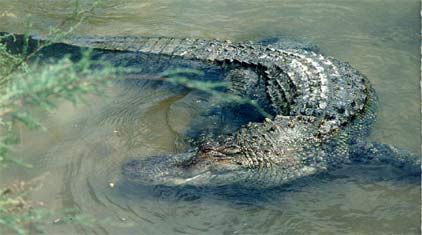
After drying off further up the trail, we wondered if we should notify someone. Sooner or later some other hapless hiker would follow the trail across the wadi, where a very antagonized alligator might be awaiting its dinner. But we had just consumed a full box of halva, and were too sated on sugar to care.
From here, the trail heads along the coast to an Arab fishing village, then turns east towards the Carmel Ridge, where Elijah supposedly tangled with the prophets of Baal. What other adventures lay in store for us, we wondered, languidly laying back on the grassy slope, feeling the warm Middle-Eastern sun melt away the trauma of our reptilian encounter.
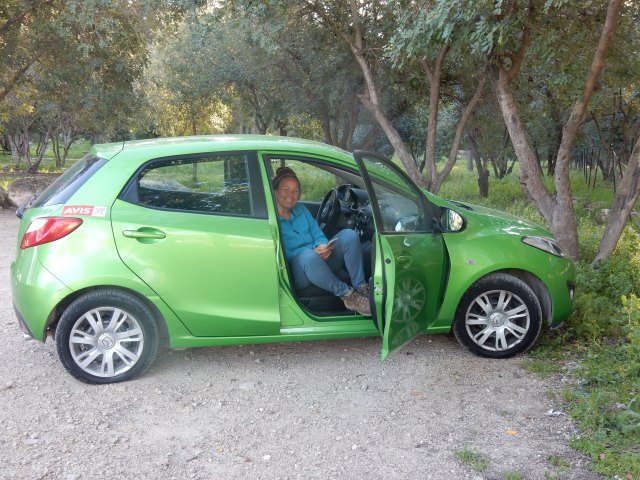 frog green Mazda 2, heading north towards the Sea of Galilee (known as Kinneret here). We passed through Nazareth but didn’t stop to see the tourist attractions, which are always full of buses filled with school kids, or foreigners, old and young. Early afternoon found us outside Tiberius. We stopped and ate some oranges, then carried on a bit further looking for a camping spot. A couple of signs piqued our interest. One was for a first century Jewish village and fishing boat. We found the parking lot (empty except for a devout Arab saying his prayers), but no signs to any historic site. Following a dirt track, we came to a small generating station, then another track that headed down to a ramshackle sea resort: cabins on the verge of collapse, lodges in various states of disrepair, a concession stand, a main lodge also in desperate need of repair. Turns out people store their boats there and the resort itself opens later in the season. For our purposes, it was perfect! Running water, steps to the lake, shade, power to charge our devices plus the bonus of two lovely golden retrievers, one that just gave birth to nine puppies. When the night security guard showed up we asked if we could pitch our tents, he agreed, and so we stayed, secure, behind closed gates, while the foxes howled on the track to the lake.
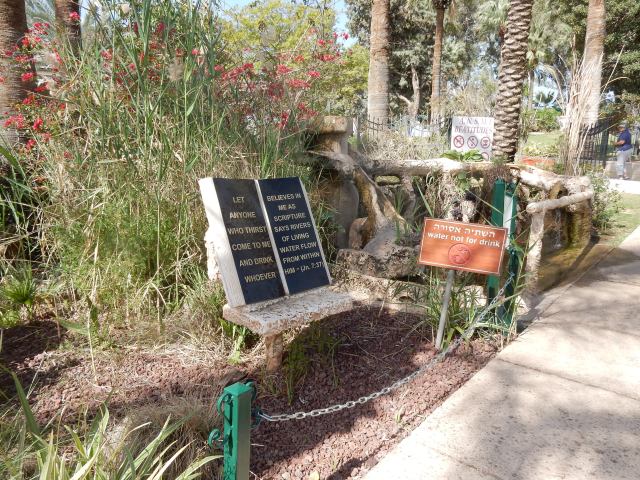 The church was also lovely but what made it seem other worldly was that a couple of priests were singing Santa Lucia in the most awesome tenors, which resonated throughout the round sanctuary. Arlene captured it on video.
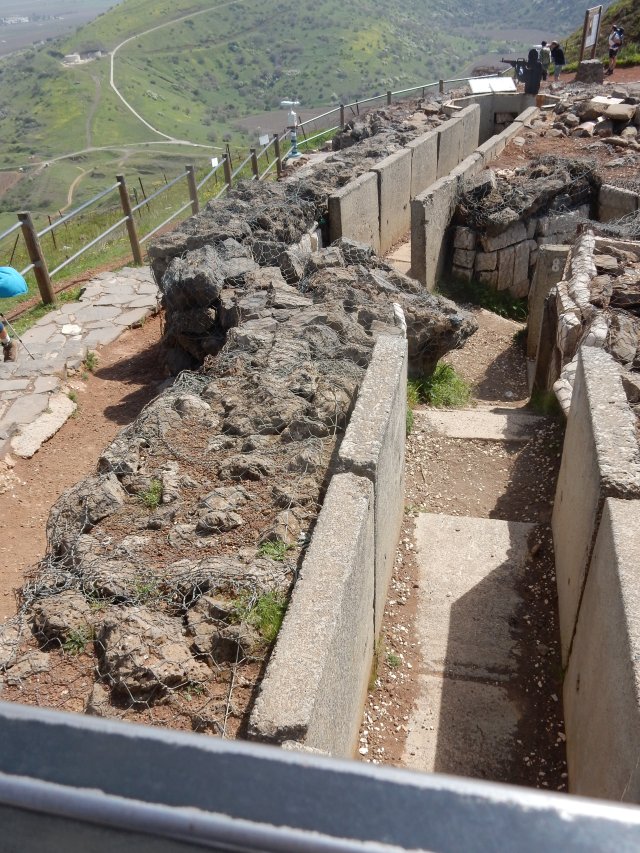 peacekeepers who were stationed in the area, overseeing the ceasefire dating back to 1974 when the Syrians occupied this part of Golan. The peacekeepers, one from eastern Europe and one from Ireland, pointed out the decimated Syrian villages to the east and the boundaries of the UN demilitarized zone between Syria and Israel. Apparently both governments currently maintain friendly relations. We sensed the area evoked strong sentiments for both sides in the conflict. This sentiment was confirmed while we ate some lunch in the gift shop/ café, for we noticed many people praying, reading from their holy books ( either Koran or Torah) and crying and bowing twice towards the walls. The grief associated with the conflict was palpable, and both Arlene and I actually cried while witnessing the mourners.
 one of the prominent hills, but by the time we got there at 3:00 pm, it had just closed. So Nimrod Fortress was put on the next day’s agenda. Back down we drove, through the green, rocky hills which looked so stunning in late afternoon light. We picked up a young German hitch hiker who tagged along on the rest of our adventures that day – an unplanned visit to the Lebanese border ( not sure how we ended up there) and to Kibbutz Dan, where we would have arrived victorious in April had we walked the entirety of the trail. We ended up camping in the kibbutz near the first/ final rock of the Shvil. Arlene cooked up one of her specialties seeing as we had a dinner guest, namely young Constantine, the German. In the morning he took off down the trail and we loaded our stuff into Kermit and headed out to Nimrod.
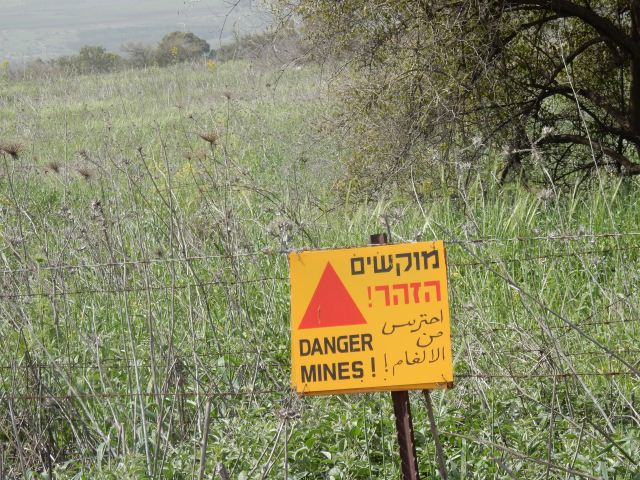 countryside with its bombed-out shells of houses, past the Valley of Tears. For part of the ride south, we were only a few kilometres from the Syrian border. Golan was quite the experience and we were glad we had come to this part of Israel.
 met some American tech workers and Joe Biden’s entourage – already soaking up the ambience of Jerusalem and the American tax payers’ dollars a week before Biden’s arrival. Nice work if you can get it.
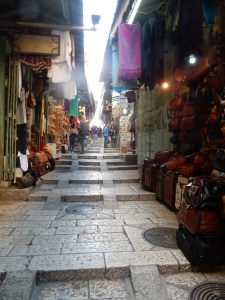
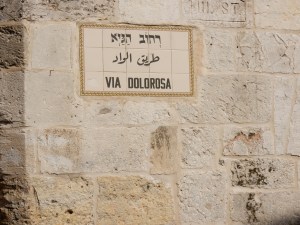 seemed to radiate into all 4 quadrants of the city: Armenian ( orthodox Christian), christian, Moslem, and Jewish. We went to the Church of the Holy Sepulchre, the site of the crucifixion and were both inexpressibly moved by the slab of rock where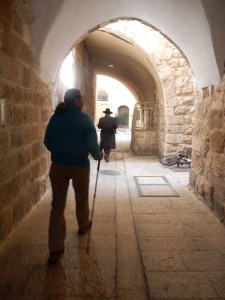
 Jesus was laid out and washed. The church is built around the hill where the crucifixion took place and it is obvious it has significance to Christians, Jews and Moslems alike. What struck me was that 40,000 people live and work in the old city of Jerusalem, side by side, and appear to get along well. Outside is a different story. We’ve heard news stories about attacks, mainly on soldiers and security forces in the last few days. We regularly see people in uniform and out of uniform with AK 47’s hanging
 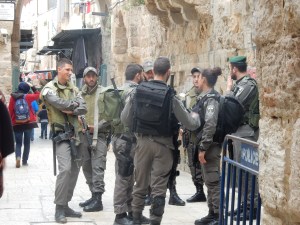 casually from their hips. On the other hand I haven’t heard of anything more than random stabbings, which is quite different from the American style gun massacres so often in the news. I planned on taking a full day tour of the West Bank – Bethlehem, Ramallah … but decided not to, not because I felt unsafe, but because of the cost ($150).
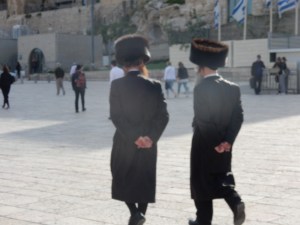 underway for the feast and traditional Jewish dancing that take place in the courtyard beyond the wall. We took the opportunity to place our hands on the wall and pray. When done, the custom is to back away from the wall, rather than turn one’s back on it. As Arlene was backing away she bumped right into the woman she met at Toronto airport who was connected to the shelter hostel in Eilat (where we started and mentioned in an earlier post) such a small world !! Turns out they were also in Eilat when we called to say we couldn’t find the water John had cached for us. Sandy and her husband have kids in Edmonton so I think we will meet up some time in the future.
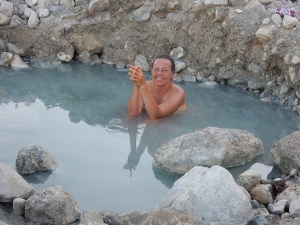 The peacefulness of the place, the unique scenery inspired me to write some poetry, which I might post when the muse overtakes me.We had great fun plastering ourselves with the medicinal black mud. Arlene sank up to her knees in it on one stretch of the beach.
 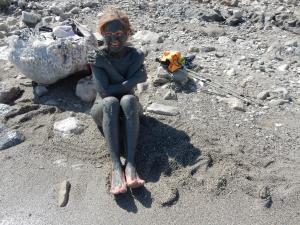 If we weren’t confined to our backpacks, which have negative capacity at the moment, we could bring back a load of mud for everyone to enjoy!
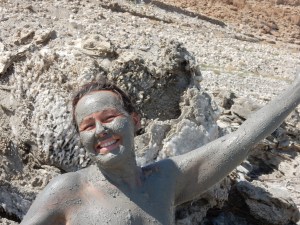 It does make your skin soft but the salt water you have to rinse in eliminates the therapeutic effects of the mud. By the time we left we were both feeling quite pickled.
  The novelty of shrivelled, tight skin and cardboard clothing wore off. Having only a litre of water ( and it was 30c ) and only powdered eggs left, it was time to leave. We packed up and hiked the 2 km back out to the highway. While we were waiting for a ride, a car load of 4 rabbis started down the rocky trail, presumably to the hot pools. Would they have doffed their black robes and sat in the burbling pools when they discovered our tents?? Mmm, an amusing scenario.
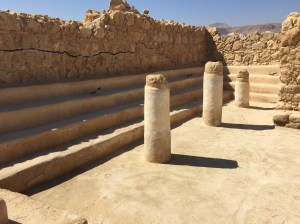 After a rather unpleasant night on the beach ( which by the way has an eclectic array of garbage on it- surprising, that Israelis, all who express a love for the beauty of their country, seem reluctant to pick up their trash!!), what with traffic and people walking along the beach in the early hours of the morning, we packed up, walked over to the hotel, helped ourselves to a couple of lemon Popsicles, and went up to the road to wait for the bus to Masada. Our painkillers had kicked in and, other than Arlene’s shorts suffering a major seam failure and the bus driver trying to cheat Arlene out of 50 shekels, we arrived at the entrance to the ancient fortress stoked with excitement. We bypassed the snake trail in favour of the cable car, stowed our packs and checked out the site. MASADA was built by Herod who, in typical megalomaniacal ( is that a word??) fashion, built a number of palaces complete with huge storage rooms and public pools. I can only imagine the labour required to fill the cisterns with water and then have that water carried up such a forbidding pile of rock. After Herod’s death the palaces fell into disrepair but the fortress was taken over by anti Roman rebels. ( Jewish freedom fighters). When besieged by Roman forces in 73AD they chose to kill themselves rather than be enslaved. Later inhabitants, included monks and rabbis, used the ruins as a spiritual retreat as evidenced by the synagogues and Byzantine church complete with mosaics. It’s been a while since I’ve had the pleasure of viewing such a significant archaeological site!
 The Peripatetic Pen